
I was a tax attorney before I started building tax software, so I know how important it is to have every client detail up front. One piece of new or changed information can cause ripples through every line in a tax return, and it can turn an otherwise-solid tax plan upside down.
That's why we place such an emphasis on the number of state and federal tax forms (and schedules) Worthy can accurately parse. These forms aren't a footnote on our product spec sheet. They're the foundation for everything our tax planning platform can do.
175+ forms. Every state by year-end.
We didn't set out to offer the most comprehensive coverage of any tax planning software. We were simply trying to get financial advisors the information they needed to perform insightful, accurate tax analysis.
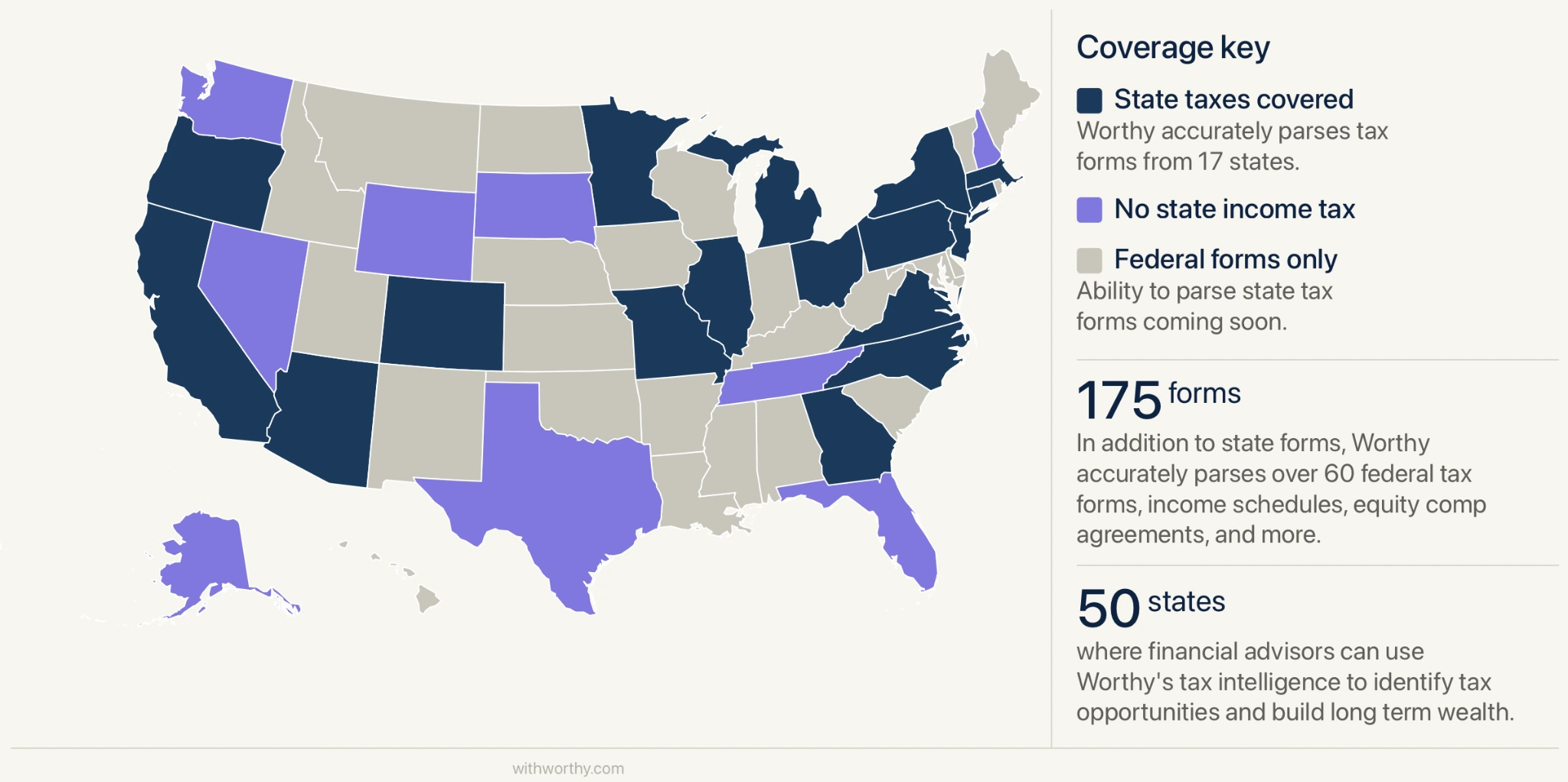
As a result, Worthy currently ingests and accurately extracts data from over 175 different tax documents, including 60+ federal forms and schedules and state-level documents from the 17 of the most populous income-tax states. This ability gives advisors a more complete tax picture for roughly 77% of U.S. households. For context, the leading platform before we came along only handled about 20 federal forms.
You can see the list of documents we currently support here, but we plan to extend coverage to commonly-used forms for all 41 states with income tax forms by the end of this year.
More information leads to better planning
A 1040 tells you a lot. But the real opportunities live in what surrounds it.
Take business owners doing Roth conversions. If I don't have their Schedule C data, I might recommend conversions that look great in isolation — tax-free growth, no RMDs — but inadvertently push them past their QBI deduction threshold, or into a higher Medicare premium bracket. That mistake may not show up at tax time. It shows up two years later, when their premiums go up and they call you to ask what happened.
Or consider a client with a new dependent appearing on their return. That one line item is actually a 20-year planning opportunity: 529s, a Roth IRA for the child, payroll from the family business — all of it unlocked by a piece of information that could have been missed without full document ingestion.
A few thousand dollars in potential savings is a meaningful reminder of why clients chose you in the first place, and having more data makes it easier to sweat the small stuff. That's especially true with state income taxes, which represent about 15% of personal income tax liability — and offer another place to look for savings.
A Roth conversion analysis or a business owner's tax picture can also look very different when you factor in retirement income exemptions, pass-through entity tax elections, and multi-state income allocation.
Where humans fit in AI-first development
To get better data from more sources, we needed a better way to extract data.
Most legacy competitors extract data using old-school OCR, which is very brittle. If a document isn't close to perfect, humans come in at the end of the process to review outputs, causing delay and security risk. Every incremental form adds to build time and operational complexity, ultimately making it impossible to scale document ingestion. That's how market leaders end up with only 20 forms.
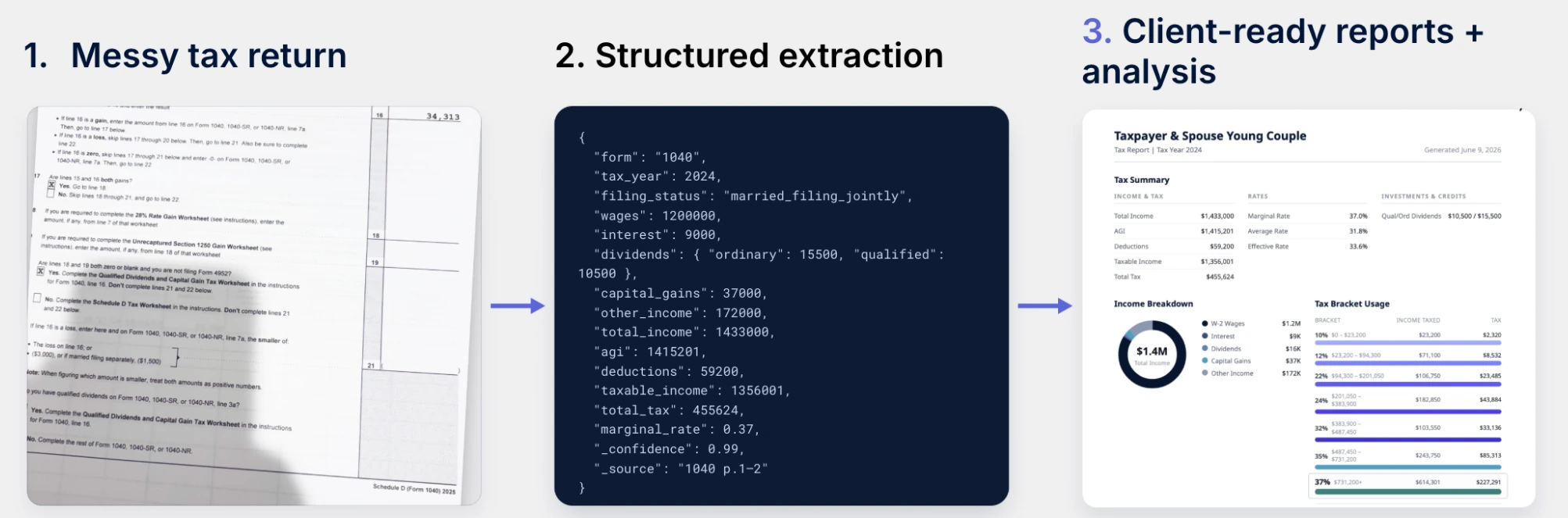
Worthy is built differently. When a document comes in — even a 1040 photographed under poor lighting, or a 2024 return with "2025" handwritten over the year — our AI-based system reads it the way a person would. It understands context. It knows what a number means and where it belongs.
While AI models are incredibly powerful, uploading a tax return directly into your favorite LLM only gets you 70 or 80 percent of the way there. Complex data extraction needs to be supervised and structured before data can be trusted.
To build this supervision layer, we put humans in the loop at the beginning of the process, instead of the end. Our team includes former tax attorneys, CPAs, and professionals who've filed thousands of returns. We've also relied on feedback from hundreds of real-world advisors to help identify potential issues and edge cases. This human-centric process has helped us develop more than 250 quality and compliance checks for our ingestion workflow.
With the right structure in place, we can add coverage fast — not because AI is magic, but because much of what we build for any one document will apply to the next one. It also empowers advisors to expand their view of clients' finances by uploading equity compensation agreements (and a few other data-rich documents we look forward to announcing soon).
Where tax data leads
Document ingestion is step one. But the same philosophy — tax expertise, controlled workflows, AI that's been trained to understand what it's handling — applies to everything Worthy does downstream. Scenario modeling, compliance guardrails, calculation accuracy, audit trails, and reporting benefit from the mix of better data and controlled workflows.
We built this way because we believe better tax data is where everything good in this industry begins. More complete information means more planning opportunities, fewer blind spots, and advisors who can genuinely serve every client — not just those who fit into rote Roth conversion projections or are valuable enough to justify hours of manual review.
See the full list of forms Worthy supports in our knowledge base. If you haven't tried it yet, we invite you to start a free trial (no set up needed). To get answers and see how it works, schedule a quick demo.