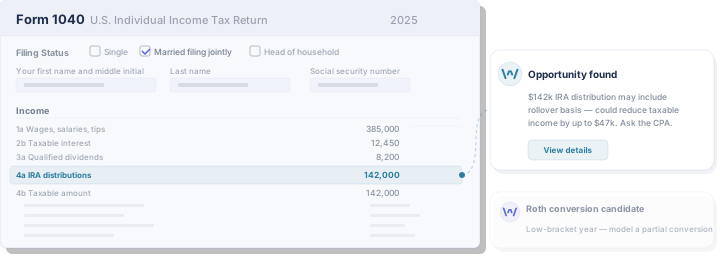

In March and April, you have a brief opportunity to offer a uniquely valuable service by reviewing clients' draft tax returns.
You'll build stronger relationships with clients, you'll be ahead of the ball the rest of the year, and any tax savings you uncover will prove your value in a tangible way.
We wrote this guide to show you how. It's inspired by smart advisors, like Michael Kitces, who have discussed the idea in the past. We'd never seen an in-depth playbook for advisors to follow, so we pulled together the best thinking we could find online, looked at how advisors use Worthy's tax planning software, and queried our in-house experts.
The result is a step-by-step checklist for a pre-Tax Day review. If it seems like a lot to accomplish, we'll also go over how Worthy's tax intelligence can amplify your efforts.
Why this moment is different
According to IRS data, more than half of individual returns are typically filed in a tight window between early March and mid-April.
That means it's your time to shine, because:
- It's the one time of year most clients are totally engaged and organized
- CPAs are heads-down, not available for planning conversations, and more reactive than proactive
- Any issues or opportunities you spot will immediately translate into real-world savings
- Getting a sneak preview of tax returns gives you a head start on planning you'll undertake right after Tax Day (when CPAs will have more time to advise clients on your big ideas).
There's also potential downside to being passive this time of year.
For example, any client who receives unexpected tax bills (from things like a Roth conversion or a distribution that was misreported) is likely to blame their advisor. Identifying potential issues and proactive communication will show you're on the ball. And in times of volatility (when numerous sources found advisor churn rates are highest), you'll be thwarting the top relationship killer: poor communication.
Here's what you'll need to do to add value and avoid common pitfalls this time of year.
First, get a copy of the draft return
This only works if you have the return, so go ask for it.
A simple message to clients in March or early April is enough:
"Before your CPA files, I'd love to take a quick look at your returns. A second pair of eyes never hurts, and it'll help us identify new opportunities."
Most clients won't hesitate. Just frame it as part of your service, not an extra request.
For new clients: You'll probably ask for prior-year returns as part of their onboarding. If you haven't yet, ask for their prior return in addition to their draft return. Having two returns to compare will give you a lot more insight.
One habit that pays dividends here: Well before tax season heats up, sending clients and their CPAs a plain-language prior-year tax summary letter is a smart way to remind clients of everything you're doing while keeping CPAs a step ahead of potential issues or fire drills. It also primes clients to loop you in when the draft return is ready. See more on year-end summaries in the CPA section below.
Once you have the draft return, here's how to analyze it:
1Check for errors
Even careful CPAs miss things, especially on complex returns with multiple income sources, rental properties, or retirement distributions.
Start your review by spotting errors or discrepancies in areas you've advised on. Every client will be a little different, but here's a partial checklist to consider (if you write a year-end summary, you can use it as a custom checklist):
- Are OBBBA changes accounted for? SALT tax deductions are probably the biggest change, but small business and startups may be affected by depreciation and QSBS updates. Clients' gift and estate planning strategies may also be impacted. See an overview from Cozen O'Connor.
- Are Roth conversions reported correctly? Do conversions and distributions show as taxable when they should? Is there missing or incorrect timing information, like treating late‑year conversions as if spread through the year?
- Are Qualified Charitable Donations reported accurately? Were QCDs from IRAs excluded from taxable income? Does the 1099‑R line up? Is there any double counting in Schedule A?
- Were any rollovers treated as taxable?
- Are there missing or incomplete 1099s? Perhaps from old/closed custodian accounts? Were all 1099 composites included? Are there any missing dividends or interest?
- Were there withholding or estimated tax issues? Does IRA withholding match up to contributions? Could any late‑year conversions lead to underpayment penalties that could have been mitigated with annualization or better planning?
- Does everything make sense? Are there large new income items that don't fit the client narrative (like a big taxable IRA distribution for a mid‑career client that should have been a rollover)? Have any schedules or income sources suddenly disappeared?
Focus your attention on the following forms and schedules: the 1099‑R, Schedule 1/2/3, Schedule A (for QCD double‑counting), Schedule D, Form 8949, and the withholding estimates.
For a thoughtful look at these concepts with a focus on reviewing 1099-R forms, we recommend listening to this conversation between Steven Jarvis of Retirement Tax Services and Michael Kitces.
The Worthy app reads tax returns in seconds and flags distribution anomalies, missing deductions, and other issues automatically. It makes it easy to review all your clients' draft returns before April 15.
2Do a year-over-year comparison
Review last year's return alongside the draft to identify any major changes. Keep an eye out for:
- Income shifts: W-2 to 1099, new business income, a rental property appearing or disappearing, etc.
- Deductions that changed size or vanished entirely
- New forms or schedules you haven't seen from this client before (like a K-1, a 529 disbursement, a new Schedule E)
- Estimated tax payments: Identify how any current underpayment penalties are occurring, and look ahead to help identify issues that could trigger future penalties.
Also watch for IRMAA creep. One-time income events like a large Roth conversion, a property sale, or a big year-end bonus can push a client into a higher Medicare premium bracket for the following year. If it was avoidable with better planning, that's a conversation to have now.
And account for new tax laws. The One Big Beautiful Bill Act introduced meaningful changes for many 2025 and 2026 returns. Most importantly, new deductions for seniors and overtime workers, changes to QBI phaseouts, and updated SALT rules. Your clients probably won't know to ask you or their accountant about it, but you can make sure any issues are surfaced.
Worthy subscribers can simply ask: "What OBBBA (or other) changes in the tax code will affect this client this year? Generate a checklist to review with their CPA and a table showing how their tax liabilities have changed." It's a simple way to cross off a complicated to-do in seconds.
3The discovery review
For new clients (or when you encounter a new form or schedule in an existing client's return) treat the pre-filing review like an initial intake interview.
The tax return inevitably reveals things clients can overlook, such as:
- Held-away assets that surface as dividend income
- Income or depreciation from a rental property you didn't know about
- A side income or business interest that starts to earn income
- A 529 disbursement that tells you a child has started college
- The K-1 from a partnership or trust.
Every one of these items is a conversation waiting to happen. The earlier you know about them, the more valuable your conversations with clients will be.
4Scan for planning opportunities
Once you've done your troubleshooting, found quick wins, and identified any major changes or blindspots, you can start thinking about the strategic roadmap.
Here are some high-value opportunities to look for:
- Roth conversion candidates: Is the client in an unusually low bracket this year? What does the IRA balance look like relative to future RMD obligations? What about the tax burdens they'll create for the client (or the drag they could create for heirs)?
- Retirement contribution gaps: Are they maxing out available vehicles? What's the exact dollar amount needed to fully fund a 401(k), IRA, HSA, SEP-IRA, or Solo 401(k)? And are any new vehicles available to them due to a change in employment status (to self-employed, e.g.)?
- Missed (or increased) deductions: Many deductions will be the CPA's domain, but advisors should think about more than just retirement plan deductions. You can offer a lot of value around charitable giving strategies, for example, especially when the client has appreciated assets or intends to make large gifts.
- Entity structure flags: Is an LLC client generating enough income that S-Corp election would meaningfully reduce self-employment tax?
- Dependent and generational wealth conversations: Is a client supporting aging parents? Does a large IRA create a multigenerational tax problem that a conversion strategy could solve? Does a new Schedule K-1 open an estate planning thread? It's good to check in from time to time about who you're really building wealth for.
- Capital losses and carryforwards: Will accrued losses create opportunities for optimizing the tax treatment of appreciated assets?
- Gifting and charitable opportunities: Consider DAF contribution bunching or gifting highly appreciated investments to potentially increase impact while reducing tax burdens.
Ask Worthy to run a cross-book query like "Which of my clients should consider a Roth conversion this year?" It surfaces the right conversations at scale, then you can use the Roth Conversion Tool to model and present different approaches.
5Turn your insights into action
Not everything you find will require the same urgency. Sort your findings into two buckets:
1. Items to address before the filing deadline
If something you identified is going to incur a penalty or if an opportunity is about to be lost, make sure to tell the client about it before the filing deadline. Alert them or their CPA about:
- Errors, missed deductions, or misreported distributions
- Additional IRA or HSA contributions
- Estimated tax payment adjustments for Q1
2. Items to start planning around (but discuss later):
The weeks after April 15 are ideal for proactive outreach. Clients and CPAs are organized and up to speed, so it's a great time to start new conversations about things like:
- Roth conversions + IRMAA mitigation
- Maximizing contributions going forward
- Adjusting estimated payment schedules
- Identifying tax moves that must happen before December 31st.
- Entity structure review
- Estate planning triggers
- Optimal gift and charitable giving planning
Schedule the conversations for May or June, when the CPA has resurfaced and has bandwidth.
Remember you're doing tax planning, not tax advice. Planning means laying out options, modeling scenarios, and exploring tradeoffs—which clients then act on in consultation with their CPA. Staying compliant will also keep you from stepping on the CPA's toes.
Working well with the CPA
Be mindful of the CPAs' priorities (and their likely stress levels). Definitely bring up urgent issues before filing, but save planning conversations for summer when they have room to engage as true collaborators.
Also consider starting the tax cycle on a collaborative note by sending each client a plain-language year-end summary in January that calls out Roth conversions, QCDs, harvested losses, account closures, or any other context that helps the CPA understand the client's tax picture.
The benefits of being a good partner can go far beyond cleaner returns. Advisor coach Dave Zoller's research on referrals found that introductions from accountants and attorneys are among the most valuable sources of new clients. Worthy's customizable reports can make it a lot easier to share details like planned Roth conversion strategies.
Making it manageable
The advisors who deliver this kind of value consistently aren't necessarily working more hours. They're just showing up at the right moment and being a valuable part of the process.
The lift to review draft returns is smaller than it looks, especially if they trickle in over the course of a few weeks.
Put together a checklist (steps 1 through 4 above hit most of the highlights), then delegate first-pass review to a junior advisor or paraplanner. For smaller clients with less complex taxes, verify any findings and pass them on. For larger clients, use the first pass as a starting point, then dig a little deeper. If you do one, remember that you can use your tax summary letter as a secondary checklist.
And if you want to provide this level of service in minutes instead of hours, check out Worthy's tax planning capabilities. Worthy's AI tax intelligence can:
- Process all tax forms and schedules in seconds
- Automatically call out errors and inconsistencies
- Model Roth conversions and equity compensation decisions (with client-ready projections and language)
- Answer any question you or your clients have
- Ask cross-book queries to identify issues at scale
Worthy is the easiest way to turn your insights into action. Get a quick demo or see what it can do with a free 30-day trial.