
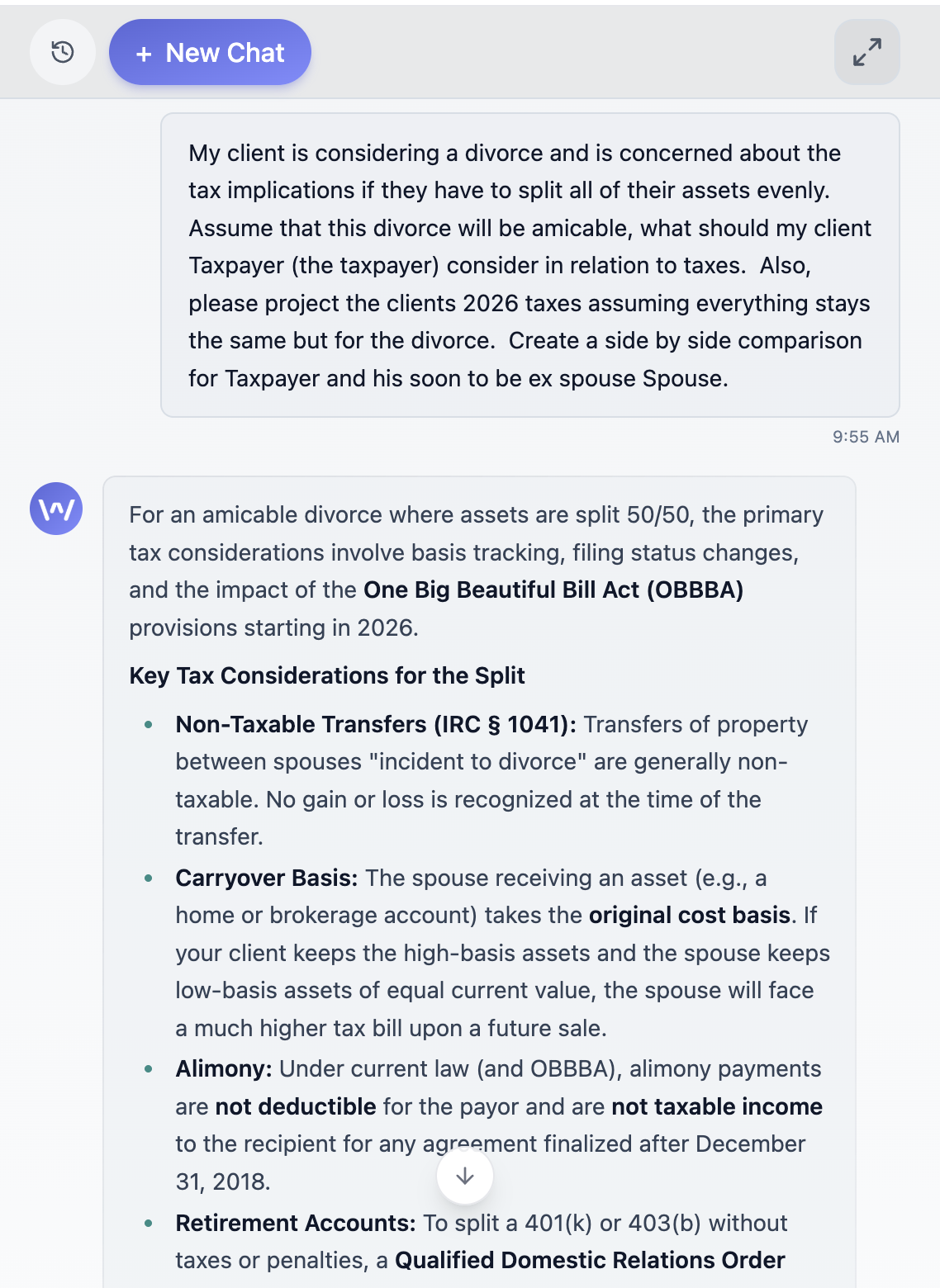
When you import a client's tax return, Worthy instantly surfaces key information and makes it easy to build reports or run Roth conversion calculations. It's a great starting point, but Worthy really shines when you start to use the chat functionality.
From instant answers for client questions to modeling complex scenarios, chatting with Worthy is like having a tax-intelligent paraplanner by your side. Worthy remembers everything it learns about a client, it writes in clear, client-friendly language, and you can add anything you see to client reports with a single click.
To help you take advantage of everything Worthy can do, we've pulled together some of our favorite prompts and best practices for using Worthy's chat. Try them out (or give your own ideas a spin) to help clients identify potential short-term tax opportunities and support long-term planning.
Examples in this guide are hypothetical and for illustration only. Worthy provides analysis and modeling, not tax, legal, or investment advice — always review outputs and exercise your own professional judgment before speaking with clients. Not all advisors have access to the full suite of Worthy features described in this article.
What you'll need
The quality of your analysis will only be as good as the information that's available. Before starting a tax planning conversation — with or without Worthy — try to have some or all of the following available:
The most recent tax return:
- You can learn a lot from a single 1040. It's the best starting point for analysis in Worthy.
The prior year's return:
- Year-over-year comparisons often reveal the most interesting changes and opportunities
Income documentation:
- W-2s, 1099s (and most income schedules)
Additional forms:
- Worthy accepts over 20 additional IRS forms. See a full list.
Client context (type these directly into the chat)
- Income trajectory, life events (new business, marriage, divorce, death of spouse, relocation, retirement, parental leave), etc.
- Any planning actions taken during the year (Roth conversions, tax-loss harvesting, charitable gifts)
- Any other details it should know: anticipated income sources, assumptions, changes, etc.
It just takes a few seconds to upload tax documents into Worthy, and you can type any additional context directly into chat. Worthy will remember everything and use it to produce client-specific answers, models, and projections.
Not quite ready to upload your clients' tax docs yet? We built Worthy with bank-level security and compliance-minded guardrails to safeguard sensitive information.
But if you're new to Worthy and want to try it out with fake data, we have several tax documents for fictional clients here.
Start with the basics
Before diving into specifics, a high-level summary can orient your entire analysis and make sure nothing obvious is overlooked. You'll see a lot of what you're likely to be looking for in the client dashboard, but a quick query can help frame the narrative and highlight notable issues.
We have several curated prompts that will generate an executive summary, but you can ask your own version of those questions, too.
Try asking:
"Generate an executive summary for this client covering their overall tax situation, key financial highlights, and areas of note."
"Summarize this client's tax year and flag anything unusual compared to last year."
"What are the most important things I should know about this client's tax situation before meeting with them?"
The goal here is to get a tight, client-specific summary that lets you walk into a client meeting with a clear point of view and a series of follow up questions.
For new clients, that means having a broad understanding of their tax picture, income sources, and the areas that merit more investigation. For existing clients, you'll want to identify changes in income sources, shifts in deductions, tax or Medicare bracket exposure, and anything that's outside your expectations.
Roth conversions
Roth conversions are becoming more popular, with Fidelity reporting a 36% year-over-year increase in 2024. It can be a big opportunity for your clients, and we make it easy to begin your analysis:
Try asking (with client-specific details):
"Perform a 5-year Roth conversion strategy. My client has $1M in pre-tax IRA funds. Assume zero W-2 income in 2027, 2028, and 2029. Their main concern is passing assets to heirs in the most tax-efficient manner possible."
"Compute a 5-year optimal Roth conversion strategy. If you cannot determine their pre-tax account balance, assume $500K."
"Assume my client's heirs will earn $150K over the next 5–10 years. Which strategy is more tax-efficient for both the client and their heirs? Show a comparison with only the most relevant figures. Where additional clarification is needed, prompt me to answer those questions."
As a cross-book query (more on this in Section 9 below):
"Which of my clients could be good candidates for a Roth conversion this year? Flag anyone with unusually low projected income."
Worthy offers a Roth conversion calculator as a starting point, but chat lets you make adjustments on the fly, address client-specific nuances, and compare different scenarios — so don't be afraid to get into the details.
Change the time horizon, try different income assumptions, or even compare approaches that prioritize estate planning outcomes over returns in your clients' lifetime.
Ask Worthy for a table to compare taxes and investment returns under different approaches (like conversion vs no conversion, or when taxes are optimized for the next generation).
Worthy will quickly build the model, and you can add it to a client report with a single click.
Changes to income and assets
When sources of income change, there may be an opportunity for you to be proactive. Whether it's W-2 income shifting to 1099, a client taking leave, or a new K-1, understanding shifts in income can help you identify valuable opportunities:
Try asking:
Cross book: "Flag clients with meaningful year-over-year changes in income — up or down, new sources or sources that went away — and summarize the planning implications for each."
"This client's income sources look different than last year. Walk me through what changed and what planning implications that creates."
"This client is retiring in 2026. What does their tax situation look like in the transition year, and what planning actions could we prioritize?"
"My client recently sold their business and will have significant one-time income this year. What are the most important tax considerations to address now?"
"This client is moving from W-2 employment to self-employment. What changes in their tax situation should we be planning for?"
You might have more specific questions for individual clients, but these sorts of prompts make it much easier to identify key changes. They can also help you assess potential solutions you might bring up with clients.
If a new income source creates a deduction or contribution opportunity (for example, a new Schedule C might open the door to a Solo 401(k)), you can ask Worthy to compare the potential impact to the status quo. Or the loss of an income source might create a Roth conversion window. Whatever you happen to encounter, you can save a lot of time flipping through tax returns, building spreadsheets, and writing up your ideas by asking Worthy to do it for you.
Medicare & IRMAA brackets
IRMAA (Income-Related Monthly Adjustment Amount) surcharges are one of the most common surprises for retirement-age clients. They're also poorly understood, which means it's a great opportunity for you to find savings:
Try asking:
Cross book: "Flag clients whose income trajectory is likely to trigger Medicare surcharges in the next few years."
"To avoid additional IRMAA surcharges (or reduce existing surcharges), how could I adjust Roth conversions, defer income, or use Qualified Charitable Distributions?"
"This client had a significant income year in 2024. What does that mean for their 2026 Medicare premiums, and what can we do now to limit the future impact?"
The two-year lookback used to calculate IRMAA means clients are often blindsided when their rates go up. Proactive flagging — and a concrete plan to manage it — sets the right expectations and can help surface potential tax savings.
Want a little help setting up Worthy and seeing what's possible? We'd be happy to show you everything can do and set up your first client — just schedule a demo.
Missed deductions and credits
Tax season is a busy and stressful time for everyone involved, and sometimes balls get dropped. From a client forgetting to share new information to a data entry error along the way, it can be helpful to have an extra set of eyes on tax returns.
Worthy already calls out any errors or inconsistencies on each client's dashboard, but you can use chat to turn over even more stones:
Try asking:
Cross book: "Identify self-employed clients who aren't claiming the home office deduction."
"What are the key tax deductions available for this client based on their uploaded documents?"
"Does this client appear to be missing any deductions based on their income profile and prior returns?"
"This client made charitable contributions to a DAF last year. Are they maximizing the tax benefit?"
Whether it's a common deduction, a missed catch-up contribution, or suboptimal charitable giving plan, there are a number of ways clients can miss out on savings opportunities.
Retirement contribution gaps
Optimizing tax-advantaged accounts is one of the most concrete ways advisors can make an impact. And the math is straightforward, which means you can show a clear potential savings gap.
Try asking:
"Compare this client's income to contribution limits across all relevant account types. Show the exact dollar gap to max out their 401(k), IRA, HSA, and SEP-IRA."
"This client owns a business and doesn't have a retirement plan. What tax savings might they see if they established one, and what options could they consider now?"
"Are there catch-up contribution opportunities this client could potentially be taking before April 15?"
Underutilizing retirement and other tax-advantaged plans can mean missing out on potential tax-advantaged savings. Whether it's a small contribution gap or an opportunity to contribute tens of thousands of dollars, this is a great way to keep clients on the right path.
Business entity selection
For business-owning clients, choosing the right entity structure can meaningfully reduce self-employment tax. Using the right type of retirement account can also allow them to save more for the future. Worthy makes it easy to model the impact of potential optimizations:
Try asking:
"S-Corp vs. LLC — what appears to be the optimal structure for this client's self-employment tax situation?"
"This client has business income. Are there retirement plan options they aren't using that could significantly reduce their tax liability?"
"Review this client's Schedule C. Are there deductions they appear to be missing based on their industry and income level?"
Cross-book: "Flag business-owning clients who might benefit from switching to a different entity type or a different type of a retirement plan."
With self-employed or business-owning clients, ask about S-Corp elections, unreimbursed business expenses, retirement plan opportunities, and QBI deduction optimization. These clients often have the most potential upside.
Life events
Sometimes tax returns can tell you more than a client does. And you may encounter unfamiliar situations when life events force a change to your tax or investment strategies. Worthy can help identify major changes like a move or the birth of a child, and it can help you analyze the impact of events like a divorce or inheritance.
Try asking:
Cross book: "Did any clients move, add or subtract a dependent, switch from joint to individual filing (or vice versa)?"
"How are asset transfers, alimony, and QDRO distributions taxed for a client going through divorce?"
"This client's spouse passed away last year. What are the tax implications, and what filing status changes should we plan for?"
"My client relocated to a different state this year. What are the tax implications, and is there anything we should address before the return is filed?"
"This client started a new business this year. What first-year tax considerations should we be discussing?"
Once you identify changes, you can dig into potential planning opportunities. Worthy helps you do both.
Cross-book analysis
CEG insights found that 92% of clients expect help with tax planning from their financial advisor. But regularly identifying issues and opportunities can be hard.
Worthy's ability to perform cross-book queries gives you a way to identify clients with potential opportunities without manually scrutinizing every 1040 and K-1. You bring the insight, and it does all the legwork.
Try asking:
"Which of my clients could be good candidates for a Roth conversion this year?"
"Which clients are likely to be most impacted by changes in the new OBBBA tax laws?"
"Flag clients who will have a lower-income year due to retirement, career change, or parental leave — and rank them by the potential tax savings from proactive planning."
"Summarize all clients and tax years. Where are the biggest outliers?"
When you query across your book, you can look for specific issues that are top of mind — or for patterns that don't jump out when viewing a single client. Whether it's clients impacted by a tax law change, clients with increased IRMAA exposure, or business owners could revisit their entity structures, a single query can show you where to dig deeper.
Reviewing returns before filing
If you have access to a draft return, one of the highest-value things you can do is stress-test it before it goes to the IRS.
Try asking:
"Assume everything stays the same for 2026 tax filing. Create a pro forma of pages 1 and 2 of the federal 1040, and give me three planning opportunities with estimated tax impact."
"Review this draft return and flag any issues or opportunities before it's submitted."
"Identify and analyze a 3-year tax planning opportunity for this client covering income timing, deduction strategies, and tax bracket management."
Whether you're identifying errors before they become problems or just getting a head start on planning, reviewing draft returns is a great opportunity to be proactive. And it's a lot easier to do at scale with a tool like Worthy.
It can also help you build a relationship with your clients' CPAs (which you can reciprocate by sending over year-end tax summaries of everything you've done). You'll provide more holistic service, and you might even earn a few referrals. See our detailed guide to reviewing draft tax returns.
Best practices for getting the most from Worthy
You know your clients, so nobody is going to be better at analyzing their situation than you. With that in mind, here are a few ways to get Worthy to home in on the most important and actionable insights:
- Ask for tables and comparisons. Whenever you're modeling scenarios (like "What if we convert $50K vs. $100K?"), ask Worthy to display the results side by side. Numbers in a table are easier to explain and easier to share.
- Ask follow-up questions. Worthy remembers every document and every detail in the conversation, but it may not know exactly what you're looking for. If the first answer is close but not quite right, push back. For example: "Now assume my client's heirs earn $150K. Which strategy wins? Show me only the most relevant figures."
- Ask Worthy to ask you followup questions. Your conversations with both Worthy and your clients will go further when they're informed by more information. When Worthy looks at a planning scenario, ask: "Is there anything else it would be helpful for you to know?"
- Request client-ready language. Once you've landed on an idea you want to share with clients, ask Worthy to restate it in clear, plain-language terms your client can understand. Everything Worthy generates is built with compliance-minded guardrails in mind, but you can also give it specific instructions about how to word its answers.
- Use "add to report" to build as you go. Whenever you see a promising insight, look for the "add to report button" nearby. One click can add anything you see in Worthy to a client report. Then all you have to do is order the report as you'd prefer and review it for accuracy.
- Don't forget the CPA. Some of the best planning conversations start with Worthy and end in a call to the tax preparer. Use Worthy to identify what to flag and how to frame it — and use the relationship to make sure the CPA knows what you did during the year before they start the return.
- Think in generations and time horizons. The most powerful questions aren't just about this year. They're about what today's decisions mean in three, five, and ten years — for this generation and the next. Ask Worthy to model both.
Finally, be sure to review Worthy's work before sharing it. Worthy is intended to support accurate, compliant work, but it's ultimately your name on any ideas that you're sharing with clients. Adding your own personal touch to client communications is also a great way to make sure you connect with clients about more than just their finances.
Log in to get started, or ask questions and see what Worthy can do by scheduling a demo.