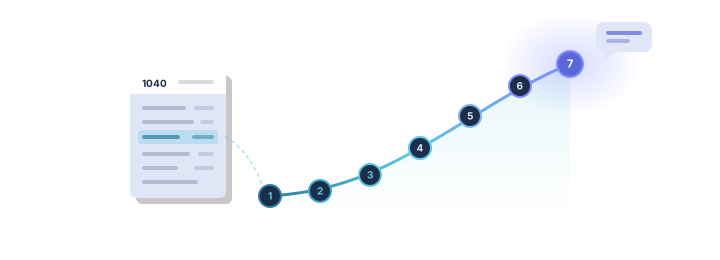

We recently talked to one of the most active Worthy users – an in-house tax strategist at a large wealth management firm. This CPA's job is to advise the advisors at his firm, and he uses Worthy daily to analyze opportunities for clients with $10 million+ in investable assets. He's developed a repeatable process for assessing each client's tax picture.
While he works with larger accounts, his approach to reviewing clients' taxes can be productive for any client. Read on for real-world insights and a step-by-step playbook for using Worthy effectively.
1Start with what Worthy already shows you
This CPA usually starts cold because he doesn't have the same relationship with clients that most advisors do. He gets up to speed by reviewing an advisor's background notes and the client's balance sheet, and he writes down things like basic biographical information and goals.
Once he has some context for the client, he jumps straight to uploading a tax return. Worthy's client dashboard instantly populates with the income breakdown, effective tax rate, and bracket positions for things like tax rates and IRMAA.
With this information in hand, the tax specialist skims the dashboard for more key details. If anything jumps out to him, he adds it to the client notes he's taking – before he starts prompting.
Do this: Upload the return, skim the dashboard, and flag anything that jumps out — an error worth double-checking, or an opportunity worth digging into later.
"Even with clients you know well, try to come at the return with fresh eyes. Ask yourself what the real story is here — what they actually want out of this, not just what the numbers say."
2Establish the baseline
Next, ask Worthy for a straight overview of the prior-year return — what was reported, what elections were made, what may have been missed. The tax specialist deliberately stays "within the four corners" of the tax return here: no goals, no future, just ground truth.
This step will complete your basic tax picture, and it can also turn up quick wins, like a missed election, or an opportunity to be more efficient by using appreciated stock instead of cash for charitable giving. These sorts of quick wins can be a great reminder of the value you're adding to clients.
Prompt idea:
"Review last year's tax return. What was reported, what looks unusual, and what elections or opportunities might have been missed?"
"Resist the urge to jump straight to planning. A shaky baseline undermines everything you build after it."
3Tell Worthy what it doesn't already know
Next, you should brief Worthy the same way you'd brief a specialist coming to a client cold. It doesn't know the age of a client's children, that they're planning to sell a business in five years, or that they've been quietly covering care costs for a parent — unless you say so. None of that shows up on a 1040, and all of it can impact planning.
This tax pro makes sure that Worthy has the same client context he does. He pulls client notes straight from the firm's CRM — goals, concerns, things the client has said — and pastes them into Worthy's chat before he asks for anything else.
And if you have a strong relationship with clients, remember that some important context might not live in the notes at all. Make sure to share any key details that live in your head. If it's not in the chat, Worthy doesn't have it.
Do this: Copy relevant CRM or meeting notes directly into Worthy's chat — goals, upcoming changes, anything you'd mention if you were briefing someone new on the case. Don't pre-filter; let Worthy tell you what's relevant.
"Don't over-filter before you paste client notes in. Give it more than you think it needs — Worthy is good at figuring out what actually matters faster than you could sort it yourself."
4Get to work
With the baseline and the context both entered into Worthy, you're ready for a prompt that really kicks off your conversation. Even though you'll probably have a few areas you already want to explore, the CPA recommends a prompt that can confirm your instincts AND call out other potential opportunities:
"Given everything you now know about this client, what opportunities stand out?"
Once you have a full list to work from, use Worthy to pore through it one idea at a time. You can use chat – or use Worthy's built-in calculators to give a little more structure to your analysis of Roth conversions, equity compensation options, or other planning scenarios.
If you have a favorite prompt you want to use over and over, Worthy gives you the option of adding it to the default view of the client dashboard. Learn more here, or see everything Worthy can do: ask for a demo.
5Push for nuance, not just an answer
When you're evaluating a specific opportunity, treat the first answer as a draft that you need to revise.
The tax specialist's approach is blunt: "I'm just harsh and direct with the AI," he says. If a response is too long or unfocused, he says so plainly rather than trying to finesse the prompt. Tell Worthy exactly what's wrong and what you'd rather see. For example, you can ask Worthy to change a lengthy description of two competing strategies into a comparison table or a list of pros and cons.
Similarly, if a number seems too clean — like a Roth conversion projected to save $500,000 over ten years — ask Worthy to break out the math year by year so you can review it.
Prompt ideas:
"Re-read this as if you're a client trying to get value out of the report — cut anything that isn't essential."
"Give me this as a comparison table instead of a paragraph — [option A] vs. [option B]."
"Don't editorialize. Stay objective and avoid commenting on the size of any number."
"Show your work. Break this down year by year so I can see exactly how you got to this figure."
"It's like clay — it really depends on how you use it. Tell Worthy to explain its thinking, or tell it you want outside-the-box ideas and to give you everything it's got. Either way, it adapts."
6Present the big picture, then get specific
When sharing your analysis with clients, jumping straight into the weeds can be confusing. Start with the visual summary instead, and walk clients through their bracket position, IRMAA thresholds, income breakdown, and any other key details.
The tax specialist leans hard on the first page of Worthy's reports here, and he notes that clients usually like the overview materials on their own. The overview also sets the stage for a deeper conversation. For example, you establish the context for a Roth conversion conversation by showing a client that a lot of their taxable income comes from capital gains, and that they have lots of room in the 12% income tax bracket.
Once the big picture lands, move into the specific opportunities you've explored. The goal at this stage is to get buy-in on the concept you're presenting – not to forecast a specific outcome. Continuing the Roth conversion example, you'd want to show a client that converting now would give them more favorable tax treatment than if they waited until they were receiving social security payments.
Do this: Walk through the visual summary first, then move into two or three specific opportunities framed as concepts worth getting comfortable with, not final numbers.
"Clients usually feel like they're paying a ton of tax — I just point at the chart and show them where it comes from. A simple visual builds more trust than any explanation I could give."
7Get the client's tax professional involved
Explaining a tax strategy to clients without crossing into the realm of giving tax advice is one of the hardest parts of the job. To make sure a client's CPA is in the loop, the tax specialist doesn't stop at presenting the concept to clients. Instead, he re-packages the nuanced analysis Worthy produced in Step 5 to give the client's CPA a clear description (instead of starting from scratch).
This step is more than a courtesy. It makes it much easier for a client to explore potential tax efficient strategies with their CPA – something they're less likely to do if they have to explain the concept themselves. In fact, a Fidelity Investments study found that only 35% of clients were expected to complete proposed Roth conversions, so removing barriers can be an important part of the process.
It's also a genuine value-add for the tax professional, who avoids hours of legwork when the client hands them substantive analysis up front. Making life easy for the CPA makes you look good too – potentially opening up a referral pipeline.
Do this: Present tax opportunities as concepts worth discussing with their tax professional — not as definitive outcomes or a recommendation to act. Hand the professional the full analysis, not just the headline.
"I'm handing them the ball on the one-yard line. We do the legwork and the forward-looking strategy — the client's tax professional punches it in."
When to think about taxes
This process isn't just for full return reviews after filing deadlines. Side questions come up constantly when a client wants to sell concentrated stock, weighs moving to a new state, or plans to finance major purchases — and a quick chat inside Worthy can return high-level answers fast.
We've also seen that advisors can add a lot of value by reviewing draft tax returns before filing, or when they take a quick look at taxes when pitching a new client.
Whenever you choose to use it, giving Worthy data and context before moving on to broad prompts will make it much more useful when you try to drill down into specific issues. This CPA's seven steps for tax review can help find things you've been missing, and you'll be much more likely to offer clients actionable information.
"The time Worthy saves on typing and math is massive — but what it catches is just as valuable," he says. "It's like having a partner at your desk holding all this tax knowledge, just waiting to be used."
If you're looking for more ideas about how to get the most out of Worthy, check out our team's favorite prompts – or talk to us to see everything you can do: schedule a quick call.